Scripts
For what a rule cannot say in one line: a UDS conversation across several requests, a trouble-code report with descriptions, a sequence of CAN frames, a computation before an event goes out. Scripts are written in Berry, a small language in the Python family, edited and run in the browser, and a rule can start one.
Switch scripting on
Scripting is off out of the box: scripts can be written and saved, not run. Scripts › Settings › Enabled, then Submit (WiCAN restarts). The same card holds the Runtime budget (10 s by default, up to 120 s: a script past it is stopped), Allow ECU flashing (off: the UDS services that write ECU memory are refused to scripts until it is on) and Exclusive bus (on: from a script's first request to the end of its run, AutoPID polling and trouble-code scans stay off the bus).
The editor
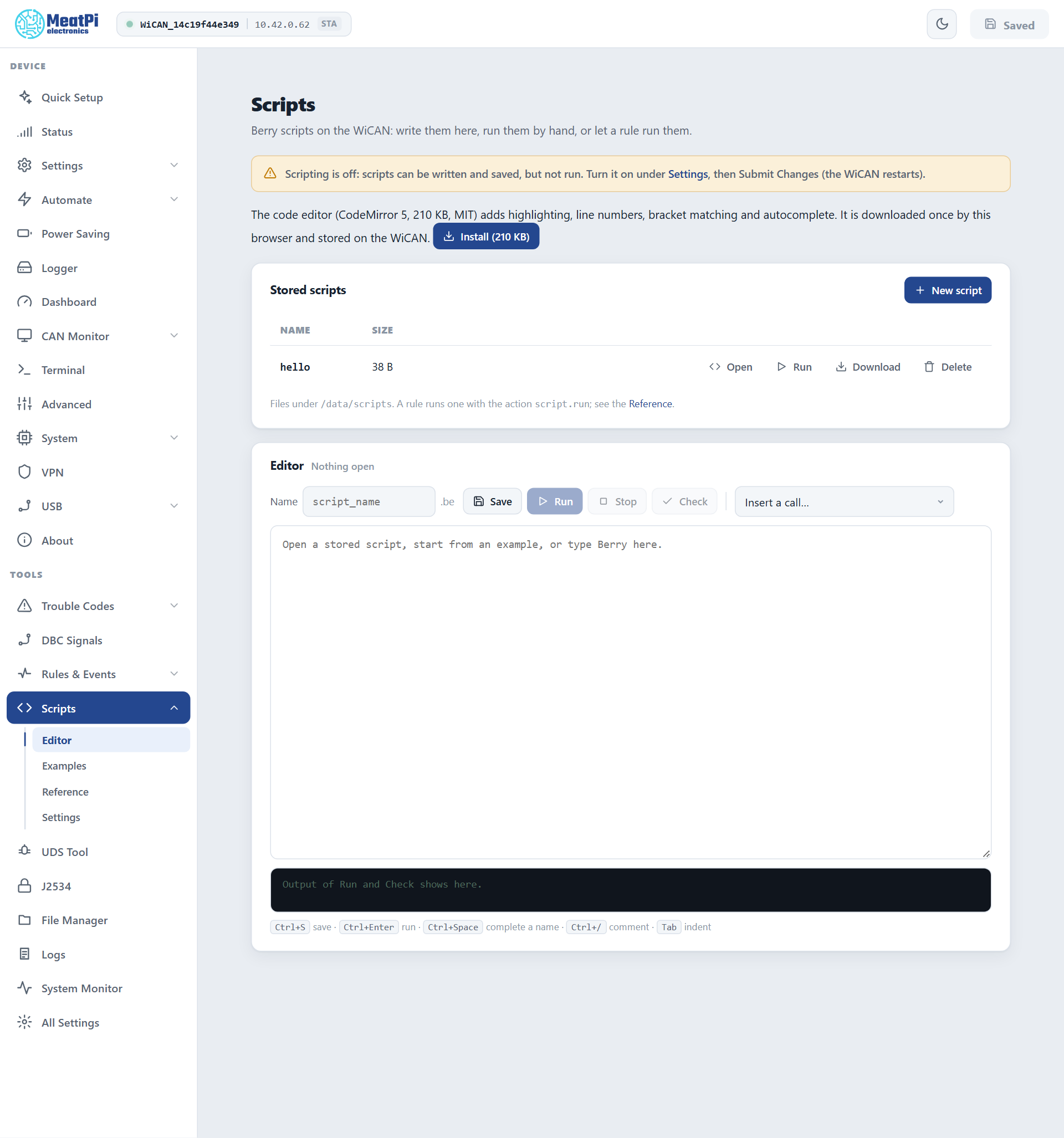
- Stored scripts lists the files under
/data/scriptswith Open, Run, Download and Delete; New script starts an empty one. Names use letters, digits,_,.and-, up to 40 characters; the.beextension is added. - The editor card: the name, Save, Run (the editor's text as it is; a script over 8 KB is saved and run by name), Stop (the kill switch), Check (compile only) and Insert a call... (every binding with its signature). The output of a run or check appears underneath: a line naming
string:<line>:is a link to that line, and a hint from the firmware shows under common errors. - Shortcuts: Ctrl+S save, Ctrl+Enter run, Ctrl+Space complete a name, Ctrl+/ comment, Tab indent.
- The code editor (CodeMirror: highlighting, line numbers, bracket matching, completion) is not in the firmware: Install downloads it once through your browser and stores it on WiCAN; a plain text area works until then.
Examples is a gallery of scripts the firmware ships, each run against the bench ECU simulator; Reference lists every binding, the readable globals, a Berry primer and the error hints, rendered from the firmware itself so it never lags behind the bindings.
Three scripts the device ships
hello: output, variables, loops and timing, nothing talks to the vehicle.
log('Hello from WiCAN')
var boot = millis()                 # milliseconds since the WiCAN booted
var total = 0
for i : 1..5                        # 1..5 is inclusive
  total += i
  log(format('step %d, running total %d', i, total))
  sleep_ms(200)                     # pause 0.2 s (the run budget keeps counting)
end
log('done in ' + str(millis() - boot) + ' ms')
vin: one UDS request, the answer as a hex string, the globals that say how it went.
import string

def text_from(resp, from)           # the bytes of a hex answer from position `from` as text
  var parts = string.split(resp, ' ')
  var b = bytes()
  for i : from..size(parts) - 1
    b.add(int('0x' + parts[i]), 1)
  end
  return b.asstring()
end

var r = uds(0x7DF, 0x7E8, '09 02')
if r != nil && string.startswith(r, '49 02')
  log('VIN (mode 09): ' + text_from(r, 3))
else
  r = uds(0x7E0, 0x7E8, '22 F1 90')
  if r != nil && string.startswith(r, '62 F1 90')
    log('VIN (DID F190): ' + text_from(r, 3))
  elif uds_nrc >= 0
    log('the ECU refused: ' + uds_nrc_str(uds_nrc))
  else
    log('no answer')
  end
end
on_event: a script a rule runs. The trigger's fields arrive as globals, and what the script emits can drive further rules.
import global

if evt_source == ''
  log('run by hand: no trigger event')
else
  log('triggered by ' + evt_source + '.' + evt_name)
end

var result = 'ok at ' + str(millis()) + ' ms'
if global.contains('evt_param')     # a field exists only when the trigger carries it
  result = global.member('evt_param') + '=' + str(global.member('evt_value'))
end

emit('script', 'done', 'value', result)   # a rule on script.done can read ${value}
The bindings
| Group | Binding | What |
|---|---|---|
| Output and timing | log(msg), sleep_ms(ms), millis() |
a line in the output; a pause (60 s at most); the uptime |
| One request at a time | uds(tx, rx, hexreq), uds_ext(tx, rx, hexreq) |
a UDS request on 11-bit or 29-bit ids: the positive answer as a hex string, or nil with uds_ok, uds_nrc and uds_pending set; uds_nrc_str(nrc) names a negative response |
| A conversation on a claimed bus | obd_claim(tx, rx[, ext]), obd_request(hexreq[, timeout_ms]), obd_isotp_tx(hexbytes[, ms]), obd_isotp_rx([ms]), obd_release() |
hold one ECU across several requests with tester present kept alive (security access, writes); raw ISO-TP frames; the claim is released at the end of the run in any case |
| Trouble codes | dtc_scan(), dtc_clear([codes[, mode]]), dtc_desc(code) |
a scan and a clear with the same gates as the page; a description from the uploaded databases |
| Raw CAN | can_tx(id, ext, hexbytes) |
one frame on WiCAN's CAN interface (normal mode, a proven bit rate) |
| Events and rules | emit(source, name, key, value) |
publishes script.done for rules to chain on |
| SD card files and flashing | obd_file_size(path), obd_file_read(path, offset, len), obd_transfer_file(path, offset, size, block_len[, bsc]) |
read a file on the SD card; stream it to an ECU as UDS transfer blocks (needs Allow ECU flashing) |
Readable globals: uds_ok, uds_nrc, uds_pending, uds_xfer_crc, uds_xfer_blocks, and from a rule evt_source, evt_name and one evt_<field> per event field. In Berry a bare name that was never set is a compile error: test with global.contains('evt_param') first.
Run a script from a rule
In Rules & Events pick the trigger, the action Run script and the script's name (the stored form is {"on": "...", "script": "name"}). The trigger's fields reach the script as the evt_* globals. An event-triggered run blocks the rule dispatcher for its duration, so keep such scripts short; a long conversation belongs to a run by hand or a timer rule with a cooldown.
Flashing an ECU from a script
obd_transfer_file streams a firmware file from the SD card as 36 transfer blocks, honours the ECU's block length and accumulates a CRC-32 in uds_xfer_crc; the script owns the sequence around it (session, security access, request download, the transfer, check memory, reset). The firmware repository carries a reference script (tools/testbench/reflash.be). It needs Allow ECU flashing on; a script that tries without it stops with a clear error.
Limits
| Script file | up to 64 KB; an inline run from the editor up to 8 KB |
| Output of a run | up to 4 KB |
| A sleep | up to 60 s per call |
| An answer | up to 128 bytes through uds(); raw ISO-TP for more |
| Runtime | the budget in the settings, 10 s by default |
| One script at a time | a second run while one is busy is refused |
Troubleshooting
| Symptom | Likely cause | What to do |
|---|---|---|
Scripting is off |
the engine is disabled | Scripts › Settings › Enabled, Submit |
syntax_error: string:3: |
a Berry syntax error on that line | click the line; the hint under the output |
busy |
another script is running | Stop, or wait |
| The run stops with a budget error | the script took longer than the runtime budget | shorter sleeps, or a bigger budget |
uds() returns nil with uds_ok false |
a negative response or no answer | uds_nrc_str(uds_nrc); ignition; the ids |
| A flashing call is refused | Allow ECU flashing is off | switch it on for the job |